

November 10, 2026 / Dentistry
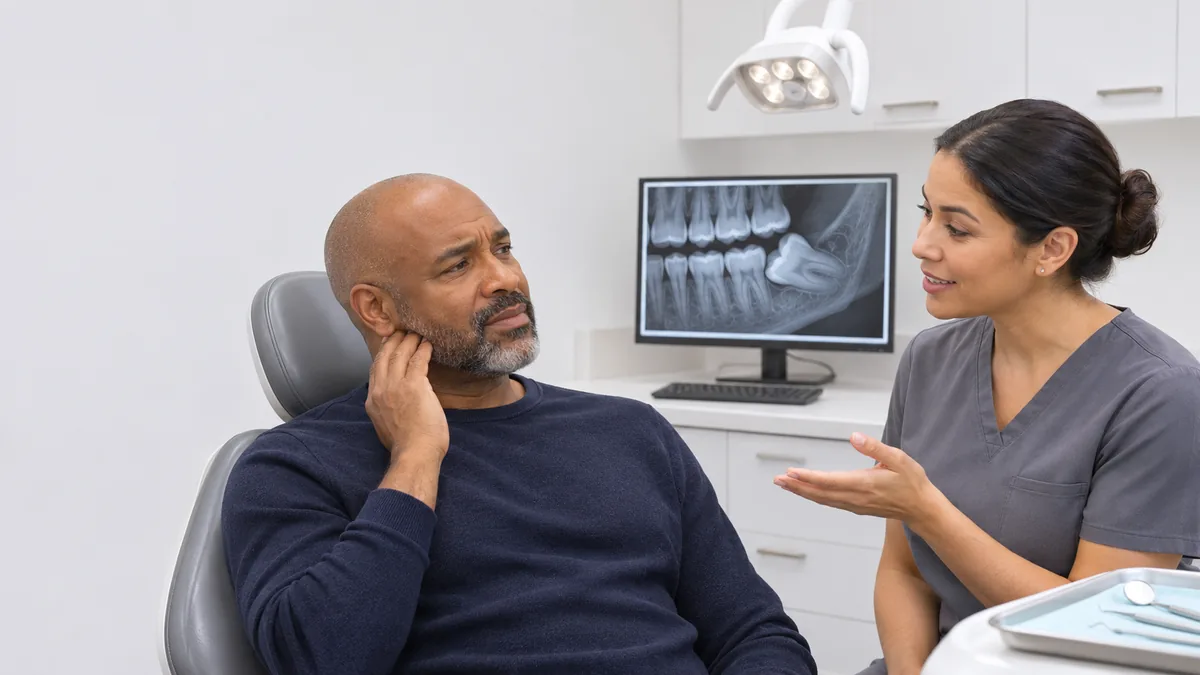
An impacted wisdom tooth is a wisdom tooth that does not have enough room to come in normally or fully through the gums. Some impacted wisdom teeth cause obvious pain or swelling. Others cause few symptoms and are first noticed during a dental examination or on an X-ray.
If you are feeling discomfort at the back of your mouth, noticing recurring gum irritation, or have been told that a wisdom tooth is not coming in normally, a dental assessment can help clarify what is happening. At Downtown Whitby Dentistry, patients can have their wisdom teeth assessed and discuss whether monitoring or wisdom teeth removal in Whitby may be appropriate.
Wisdom teeth are the third molars at the very back of the mouth. They usually develop later than the rest of the adult teeth. When there is not enough space for a wisdom tooth to erupt normally, it may remain partly or completely under the gum or become angled against another tooth.
A wisdom tooth can be fully impacted, meaning it remains beneath the gum, or partially impacted, meaning part of the tooth has come through. A partially erupted tooth can be especially difficult to keep clean because food and bacteria may collect around the gum tissue covering it.
Being impacted does not automatically mean a wisdom tooth needs to be removed. The important question is whether the tooth is healthy, can be kept clean, and is creating, or is likely to create, problems for the surrounding gums and teeth.
Symptoms can vary from person to person. Some people notice several changes at once, while others have very little discomfort.
These signs do not prove that a wisdom tooth must be removed, but they are good reasons to have the area checked.
Yes. An impacted wisdom tooth can sometimes be present without noticeable pain. That is one reason dentists may monitor wisdom teeth during routine examinations and use dental imaging when it is clinically appropriate.
A tooth that feels fine may still be difficult to clean or may be positioned in a way that affects the tooth beside it. On the other hand, a wisdom tooth that is healthy, stable, and not creating problems may simply be monitored.
No pain does not always mean no problem, but an impacted tooth also does not automatically mean treatment is required. An individual assessment matters.
A wisdom tooth assessment is usually straightforward. The dentist will ask about your symptoms and examine the back of your mouth, including the gums and nearby teeth.
Dental imaging may also be used to see the position of the wisdom teeth below the gum and how they relate to nearby teeth and other structures. The dentist can then explain what they see and discuss whether the tooth should be monitored or whether removal may be reasonable.
If you have been putting off a wisdom tooth concern because you are not sure whether it is “bad enough” to book an appointment, you do not need to make that decision on your own. You can request an appointment with Downtown Whitby Dentistry or call 905-430-7045 to have the area assessed.
No. Wisdom teeth do not need to be removed simply because they exist or because they are impacted.
A dentist may be more likely to discuss removal when a wisdom tooth is associated with repeated inflammation, pain, decay, infection, difficulty keeping the area clean, or concerns involving a nearby tooth. The position of the tooth, the health of the surrounding gums and teeth, your symptoms, and your overall treatment needs all matter.
If the tooth is not causing a problem, monitoring may be appropriate. Your dentist can explain the benefits and trade-offs of each option based on what is happening in your mouth.
Some people are more concerned about the procedure than the tooth itself. Dental anxiety, a strong gag reflex, or the complexity of a planned extraction can make patients wonder about sedation.
Downtown Whitby Dentistry offers IV sedation dentistry in Whitby for appropriate patients and procedures, including some wisdom tooth extractions. IV sedation is not automatically needed for wisdom teeth removal, and it is not suitable for everyone. Before recommending it, the dental team reviews your health history, medications, planned procedure, and individual needs.
If sedation is part of the discussion, you will receive instructions about preparation, transportation, and what to expect after the appointment.
Yes. If an impacted wisdom tooth is healthy, is not causing problems, and can be monitored safely, removal may not be necessary. Your dentist can recommend an appropriate monitoring plan based on its position and condition.
Yes. Some impacted wisdom teeth cause no obvious symptoms. They may be discovered during a routine examination or on dental imaging. That is why pain alone is not the only factor used to decide whether a wisdom tooth needs attention.
Pain at the back of the jaw can have several causes. A dentist can examine the area and, when needed, use imaging to determine whether a wisdom tooth, nearby tooth, gum tissue, or another issue may be involved.
Wisdom teeth are often evaluated as they develop in the late teens and early adulthood, but they can cause concerns later as well. If you notice pain, swelling, recurring gum irritation, or difficulty cleaning around a wisdom tooth, it is reasonable to have it checked regardless of age.
Possibly. Downtown Whitby Dentistry offers IV sedation for appropriate patients and procedures, including some wisdom tooth extractions. Whether it is suitable depends on your health history, treatment plan, and individual needs.
If something feels different at the back of your mouth, or you have been told that a wisdom tooth may be impacted, an assessment can give you a clearer answer than trying to judge it by symptoms alone.
Downtown Whitby Dentistry can assess your wisdom teeth, review any necessary dental imaging, and discuss whether monitoring or removal may be appropriate. Request an appointment online or call 905-430-7045.
The office is located at 130 Byron St. North, Whitby, ON L1N 4M9.



OUR HOURS
| Monday | 9:00 AM to 5:00 PM |
| Tuesday | 9:00 AM to 5:00 PM |
| Wednesday | 9:00 AM to 3:00 PM |
| Thursday | 9:00 AM to 5:00 PM |
| Friday | 9:00 AM to 1:00 PM (By Appointment) |
| Saturday | CLOSED |
| Sunday | CLOSED |
130 Byron St. North
Whitby, ON, L1N 4M9
905-430-7045
info@dwdentistry.ca
Request Appointment
Share or Read a Google Review

© 2026 Downtown Whitby Dentistry| All Rights Reserved - Website design by Vitamin D - Marketing & Design

