

October 18, 2026 / TMJ Treatment
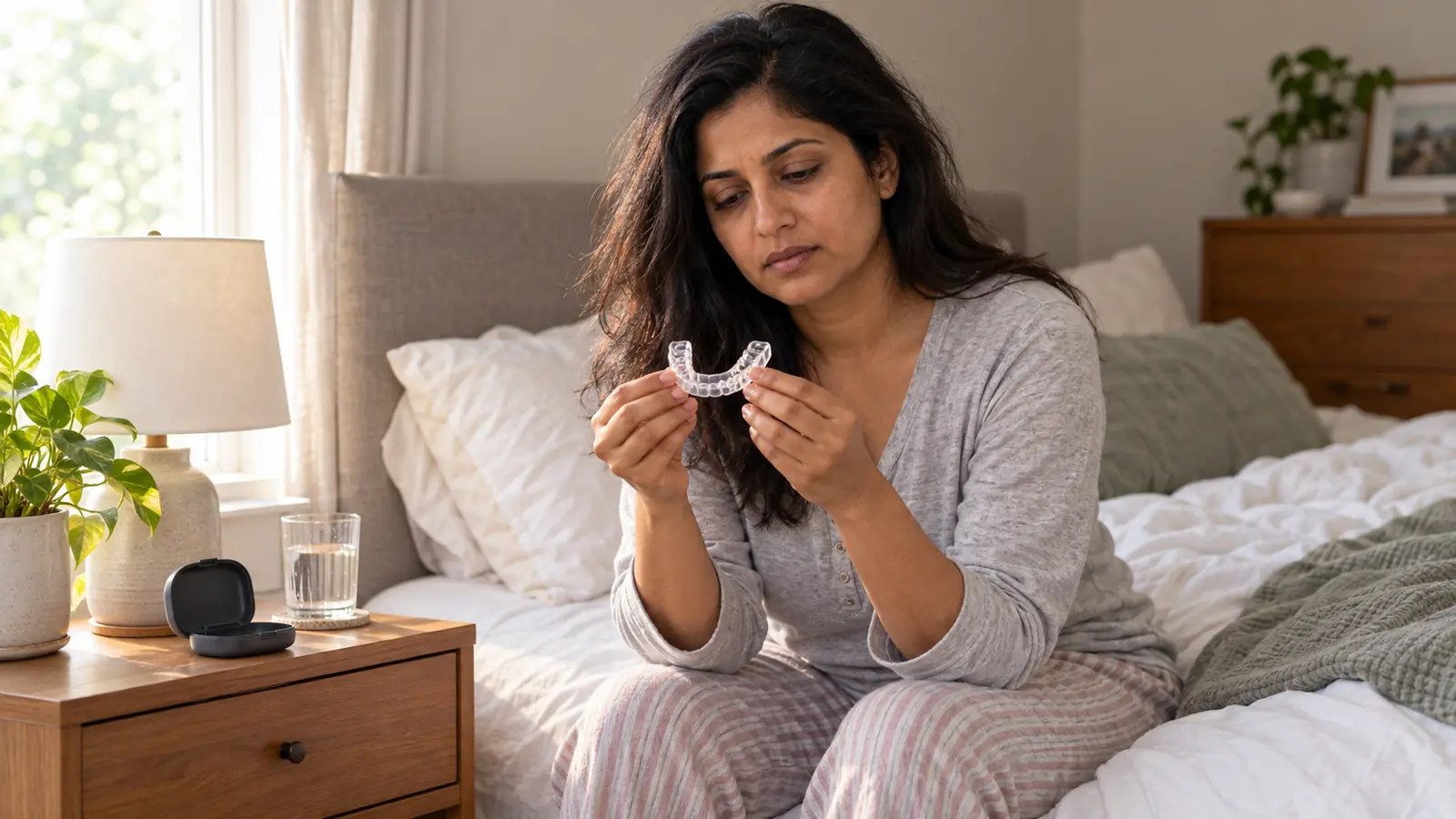
Grinding or clenching your teeth can contribute to sore jaw muscles, fatigue and headaches. But those symptoms don't prove that you grind your teeth or that you have a temporomandibular disorder. A dental or medical assessment is needed to understand what is causing the pain and what care makes sense.
If you're looking for a TMJ dentist because your jaw hurts, bring the symptoms rather than a diagnosis. When the discomfort occurs, what triggers it and whether your teeth feel different are all useful details.
Grinding involves movement of the teeth against one another. Clenching involves pressing them together and may happen without an audible sound. Both fall under the term bruxism, which can occur while awake or asleep.
TMJ stands for temporomandibular joint, the joint on each side that connects your jaw to your skull. Everyone has these joints. Saying “I have TMJ” usually means someone is experiencing a problem around that area.
TMD refers to temporomandibular disorders, a group of conditions involving the jaw joints and muscles used for chewing. Bruxism and TMD are related topics, but the terms aren't interchangeable.
Someone can notice clenching without having a diagnosed TMD. Someone else can have jaw pain that needs investigation even though no one has heard them grind their teeth.
Keeping these distinctions clear helps you ask a more useful question: “Could clenching be contributing to this pain, and what else needs to be checked?” That leaves room for an assessment rather than assuming the cause.
Repeated or forceful jaw activity can be associated with tired or sore muscles and tooth damage. The National Institute of Dental and Craniofacial Research's bruxism information lists jaw soreness, headaches and damaged or sensitive teeth among possible signs.
That doesn't mean every headache comes from the jaw. Nor does visible tooth wear, by itself, establish the cause of today's pain. A clinician needs to consider the pattern and other findings.
You may catch yourself pressing your teeth together while concentrating. Someone you sleep beside may hear grinding. These observations are worth sharing, but neither replaces an examination.
Try to describe the discomfort precisely. “My cheeks feel tired after lunch” gives a different picture from “I have a sudden sharp pain in one tooth when I bite.” If both happen, mention both.
Avoid repeatedly clenching or opening wide to reproduce the problem. Testing it over and over can make it harder to notice what happens during your normal day.
The goal is to identify a pattern the clinician can investigate, not to prove that grinding explains every symptom.
Tell the dentist about jaw fatigue, tenderness, tooth sensitivity, a chipped restoration or a change in how your mouth feels when you wake. Mention any observed grinding or awareness of daytime clenching.
A few details can make the history clearer:
Timing is a clue, not a diagnosis. Morning discomfort may prompt questions about sleep, while symptoms later in the day may prompt questions about awake habits. Neither pattern proves one cause.
If you already wear a guard, bring it to the appointment. Explain how often you use it, whether it still fits and whether your symptoms changed after you started wearing it.
You don't need an elaborate symptom log. A few examples from recent days are enough to begin the discussion. Avoid spending the day checking your bite or watching for every small sensation.
Pain around the jaw can come from different structures, and headaches have many possible causes. A tooth problem, injury, muscle or joint concern, or a separate headache condition may need a different approach.
The NIDCR's guide to temporomandibular disorders explains that jaw and facial pain may or may not be related to TMD. Assessment may require ruling out other conditions.
Tell the dentist about headache symptoms rather than assuming they belong to the same problem. Describe whether the headache is new, changing or different from your usual experience.
Sudden severe headache, new weakness or difficulty speaking requires emergency medical attention. Jaw discomfort with chest pain or shortness of breath also needs emergency help. Call 911 for these serious symptoms rather than waiting for a dental visit.
Painful locking, inability to open normally or symptoms following an injury should be reported promptly so the appropriate assessment can be arranged.
A painless click is a different situation from pain or loss of movement. Mention it, but don't assume the sound itself requires treatment. The meaning depends on the full clinical picture.
A guard may be recommended to protect teeth from the effects of grinding or clenching. Protecting tooth surfaces and treating the source of jaw pain are different aims, so ask what the appliance is intended to achieve.
A guard does not guarantee that all grinding will stop or that every headache will resolve. If pain is the main concern, the plan should explain how that pain will be assessed and reviewed.
Ask how the guard should fit, when to wear it and what to do if it causes discomfort or changes how your teeth meet. A device that no longer feels right deserves a check.
Don't adjust or reshape it yourself. Bring it back for advice if it seems damaged, tight or uncomfortable.
If you've tried a store-bought appliance, tell the dentist. Explain what changed, including whether it helped, made no difference or worsened symptoms. That information is more useful than assuming all guards are equivalent.
You should also know when the recommendation will be reviewed. If the intended goal is protecting a restoration, say so. If the goal includes symptom management, ask how improvement and any adverse effects will be assessed.
A useful plan begins with an explanation of the findings and the options that match them. Conservative care generally means approaches that avoid permanently changing the teeth, bite or jaw structures.
Ask what you can do safely at home and what should be supervised. The right advice may depend on whether the main concern is muscle pain, a joint problem, tooth damage or another condition.
Questions to bring include:
Don't begin forceful jaw exercises or agree to permanent bite changes just because they are promoted as a general solution online. Ask how any recommendation follows from your diagnosis and what evidence supports it.
If stress is part of the discussion, that doesn't make the pain imaginary. Still, stress should not become a reason to skip assessment of teeth, joints or other causes.
Downtown Whitby Dentistry offers TMJ assessment and treatment. Bring your symptoms, any existing appliance and your questions so the team can discuss appropriate next steps.
Yes. Clenching can involve holding the teeth together without the sliding movement that creates grinding sounds. You may notice it while awake, but the absence of noise doesn't settle whether bruxism is present.
No. Headaches have many possible causes. Tell a clinician about a new, persistent or changing headache rather than assuming dental treatment is the answer.
No. Jaw sounds without pain or movement problems are common and do not automatically need treatment. Report new pain, locking or reduced movement, and ask if the sound has any significance in your assessment.
Not necessarily. A guard may protect teeth, but it is not a guarantee that grinding stops or that pain disappears. Ask what the appliance is intended to do and how its effects will be reviewed.
Yes. Ongoing jaw pain deserves assessment, especially if it affects eating, sleep or mouth opening. Mention changes in symptoms when booking so the office can advise on appropriate timing.
If jaw soreness, tooth wear or suspected clenching is bothering you, contact Downtown Whitby Dentistry to discuss an assessment.
You don't need to know whether the problem is bruxism, TMD or something else before asking for help. A clear account of what you feel is the place to start.



OUR HOURS
| Monday | 9:00 AM to 5:00 PM |
| Tuesday | 9:00 AM to 5:00 PM |
| Wednesday | 9:00 AM to 3:00 PM |
| Thursday | 9:00 AM to 5:00 PM |
| Friday | 9:00 AM to 1:00 PM (By Appointment) |
| Saturday | CLOSED |
| Sunday | CLOSED |
130 Byron St. North
Whitby, ON, L1N 4M9
905-430-7045
info@dwdentistry.ca
Request Appointment
Share or Read a Google Review

© 2026 Downtown Whitby Dentistry| All Rights Reserved - Website design by Vitamin D - Marketing & Design

